Is ROBS Funding Right for Your Business? Key Questions Before You Start

Compliments of Robs Advisory Group
Rollovers as Business Startups, commonly called ROBS, can be an attractive funding strategy for entrepreneurs who want to use eligible retirement funds to start a business, buy an existing business, or invest in a franchise. Unlike a traditional retirement withdrawal, a properly structured ROBS arrangement may allow retirement funds to be used as business capital without triggering an immediate taxable distribution or early withdrawal penalty.
But ROBS funding is not right for every founder, every business, or every financial situation. It is not simply a way to “cash out” retirement savings. It is a technical structure involving a C corporation, a qualified retirement plan, a rollover of eligible retirement assets, and the purchase of company stock by the retirement plan. The IRS has stated that ROBS arrangements are not automatically abusive tax-avoidance transactions, but it has also described them as questionable when improperly structured or operated. The IRS has also noted that some ROBS-funded businesses failed, leaving owners without both the business and the retirement savings they had accumulated.
Before moving forward, entrepreneurs should take time to understand the process, the risks, and the professional roles involved. ROBS Advisory Group provides advisory and educational guidance only. We do not provide legal advice, tax advice, accounting services, investment advice, securities services, valuation services, plan administration, or ROBS setup. Those technical services should be performed by qualified attorneys, CPAs, plan administrators, valuation professionals, and specialized third-party providers.
What Is ROBS Funding?
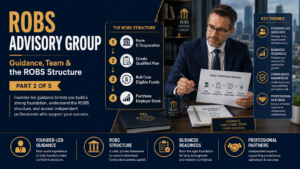
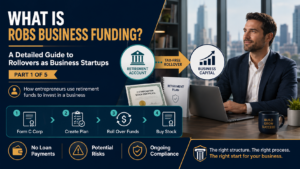
A ROBS arrangement is commonly used by entrepreneurs who want to invest eligible retirement funds into a new or existing business. In a typical structure, a new C corporation is formed, the corporation sponsors a qualified retirement plan, eligible retirement funds are rolled into that plan, and the plan purchases stock in the corporation. The corporation then uses the proceeds from the stock purchase as business capital.
This structure is very different from taking a personal loan, applying for an SBA loan, using credit cards, or withdrawing money directly from a retirement account. It can offer access to capital without monthly loan payments, but it also places retirement savings directly at risk. If the business fails, the retirement funds invested through the structure may be lost.
That is why the most important question is not simply, “Can I use ROBS?” The better question is, “Should I use ROBS for this specific business, at this specific stage, with my current financial situation?”
Question 1: Is the Business Strong Enough to Justify Retirement Capital?
The first question is whether the business opportunity itself is strong enough to justify using retirement savings. A ROBS-funded business should be evaluated with the same discipline as any other major investment.
Entrepreneurs should review the business model, revenue assumptions, startup costs, market demand, competition, margins, staffing needs, location requirements, vendor obligations, and operating risks. For a franchise, this may include studying the franchise disclosure document, speaking with existing franchisees, understanding royalties and marketing fees, and reviewing territory limitations. For an acquisition, it may include examining financial statements, customer concentration, lease terms, seller claims, equipment condition, and transition risks.
ROBS funding does not make a weak business stronger. It only changes the source of capital. If the business model is unclear, the numbers are untested, or the owner does not fully understand the operating requirements, retirement funds may be exposed to unnecessary risk.
Question 2: Do You Understand the Risk to Your Retirement Savings?
One of the biggest differences between ROBS and a loan is where the risk sits. With a loan, the business owner may take on debt, personal guarantees, interest payments, and repayment obligations. With ROBS, the owner may avoid some traditional debt, but retirement assets become tied to the success of the business.
That can be appealing, especially for entrepreneurs who want to reduce monthly debt pressure during the early stages of a business. But it also means the founder is using long-term retirement savings to fund an operating company that may or may not succeed.
Before using ROBS, owners should ask:
Do I have other retirement savings outside the funds I am considering using?
Can I afford to lose some or all of the capital invested in the business?
How many years do I have before retirement?
What happens if the business takes longer than expected to become profitable?
Will I still have emergency savings after funding the business?
A ROBS decision should be made in the context of both business planning and personal financial readiness.
Question 3: Are You Comfortable Operating a C Corporation?
ROBS funding generally involves a C corporation because the retirement plan purchases stock in the company. That means the business owner should understand the responsibilities that come with operating a corporation.
A C corporation may involve corporate tax filings, payroll, governance documents, stock records, board or shareholder actions, separate business accounts, and formal recordkeeping. This may be very different from running a sole proprietorship or LLC.
Some entrepreneurs focus only on the funding side and overlook the long-term operating structure. But the entity matters. A business owner should understand how the corporation will be managed, how compensation may be handled, how profits may be taxed, and what professional support will be needed over time.
These are not issues to guess through. They should be discussed with qualified attorneys, CPAs, and plan professionals before implementation.
Question 4: Do You Have the Right Professional Team?
A ROBS arrangement is not a do-it-yourself structure. It usually requires coordination among several professionals, including a ROBS provider, plan administrator, attorney, CPA, bookkeeper, valuation professional, payroll provider, and business advisor.
Each role is different. A plan administrator may help manage retirement plan requirements. A CPA may help with tax filings and accounting issues. An attorney may advise on legal structure, corporate documents, and business agreements. A valuation professional may be needed to support stock valuation or other valuation-related matters. A business advisor may help the owner understand business readiness and decision-making considerations.
ROBS Advisory Group helps entrepreneurs understand what types of professionals may be involved and what questions to ask before moving forward. We do not replace licensed professionals or technical providers.
Question 5: Have You Compared ROBS With Other Funding Options?
ROBS should not be evaluated in isolation. Entrepreneurs should compare it with other funding sources, including SBA loans, conventional bank financing, seller financing, investor capital, personal savings, home equity, business lines of credit, or a combination of funding sources.
Each option has advantages and tradeoffs. SBA financing may preserve retirement savings but can involve debt, underwriting, collateral, and personal guarantees. Investor capital may reduce personal financial exposure but can dilute ownership and control. Personal savings may be simpler but can reduce liquidity. Seller financing may be useful in acquisitions but depends on deal terms.
The right answer depends on the business, owner, timeline, risk tolerance, and available capital. ROBS may be one option, but it should not be treated as the only option.
Question 6: Are You Prepared for Ongoing Responsibilities?
ROBS is not just a setup event. After the initial transaction, the business and retirement plan may require ongoing administration, reporting, compliance monitoring, valuation support, employee eligibility review, and professional coordination.
Business owners should understand what happens after funding. Who administers the plan? What annual filings are required? How are eligible employees handled? How is compensation documented? How is stock value reviewed over time? What happens if the business adds employees, changes ownership, expands, raises outside capital, or prepares for sale?
Many ROBS problems arise not because the owner misunderstood the concept, but because the structure was not maintained properly after launch. Ongoing responsibilities should be understood before the business is funded.
Question 7: Is the Timing Right?
Even if ROBS may be a fit, timing matters. Some entrepreneurs are still comparing business ideas. Others are reviewing franchise options. Some are negotiating an acquisition. Others are still employed and planning a future transition.
ROBS should usually be evaluated after the owner has a serious business direction, but before signing major commitments that depend on funding. Moving too early may create unnecessary expense and complexity. Moving too late may create pressure to rush through decisions.
A better approach is to first understand the business opportunity, capital requirements, professional roles, and funding alternatives. Then the owner can decide whether ROBS deserves serious consideration.
Signs ROBS May Not Be the Right Fit
ROBS may not be appropriate if the business opportunity is speculative, the owner cannot afford to put retirement savings at risk, the entrepreneur does not want to operate through a C corporation, or the owner is unwilling to maintain ongoing plan and corporate responsibilities.
It may also be a poor fit when the entrepreneur is using retirement funds to rescue a failing business, cover unclear startup costs, or avoid difficult conversations about financial readiness. ROBS funding should support a well-planned business strategy, not replace one.
Making a More Informed ROBS Decision
ROBS funding can be useful for some entrepreneurs, but it requires careful evaluation. The decision should involve business planning, risk awareness, personal financial review, provider comparison, and qualified professional guidance.
Before moving forward, ask yourself:
Is the business opportunity strong enough?
Do I understand the risk to my retirement savings?
Am I comfortable with a C corporation structure?
Have I compared other funding options?
Do I know which professionals need to be involved?
Am I prepared for ongoing responsibilities?
ROBS Advisory Group helps entrepreneurs approach these questions with clarity. Our role is advisory and educational. We help business owners understand the ROBS process, evaluate readiness, identify planning questions, and prepare for informed conversations with qualified third-party professionals.
If you are considering using retirement funds to start, buy, or invest in a business, take time to understand the strategy before committing capital. A better decision starts with better questions.
ROBSFunding #ROBS #BusinessFunding #StartupFunding #BusinessStartup #Entrepreneurship #SmallBusinessFunding #FranchiseFunding #BusinessAcquisition #ROBSAdvisory #RetirementFunds #BusinessOwnership #StartupCapital #BusinessReadiness #FundingStrategy